Messaging Layer Security standardizes tree-based group rekeying, but LGS1 brings post-quantum encapsulation directly to group sender keys.
Messaging Layer Security MLS RFC 9420 and Livara's LGS1 protocol represent two modern approaches to solving the architectural challenges of group encryption. While MLS uses a tree-based key derivation structure (TreeKEM) to achieve efficient logarithmic rekeying for massive groups, LGS1 combines pairwise hybrid post quantum group chat encryption (P-256 ECDH paired with NIST FIPS 203 ML-KEM-768) with sender keys to provide post-quantum security without high state overhead. Understanding how both protocols approach key management, forward secrecy, and computational bounds is essential when selecting or evaluating an encrypted communication platform.
Key takeaways
- Messaging Layer Security MLS RFC 9420 reduces rekeying complexity in large groups to logarithmic time O(log N) using binary tree key structures.
- Livara's LGS1 protocol delivers post-quantum group protection by sealing pairwise sender keys inside LVR1 envelopes using NIST FIPS 203 ML-KEM-768.
- MLS requires complex tree maintenance when members drop offline, whereas LGS1 delegates attachment and group state encryption cleanly without requiring synchronized tree updates.
- Public broadcast channels are deliberately unencrypted in Livara for safety and content moderation, whereas private direct and group chats use full end-to-end encryption.
What is Messaging Layer Security MLS RFC 9420?
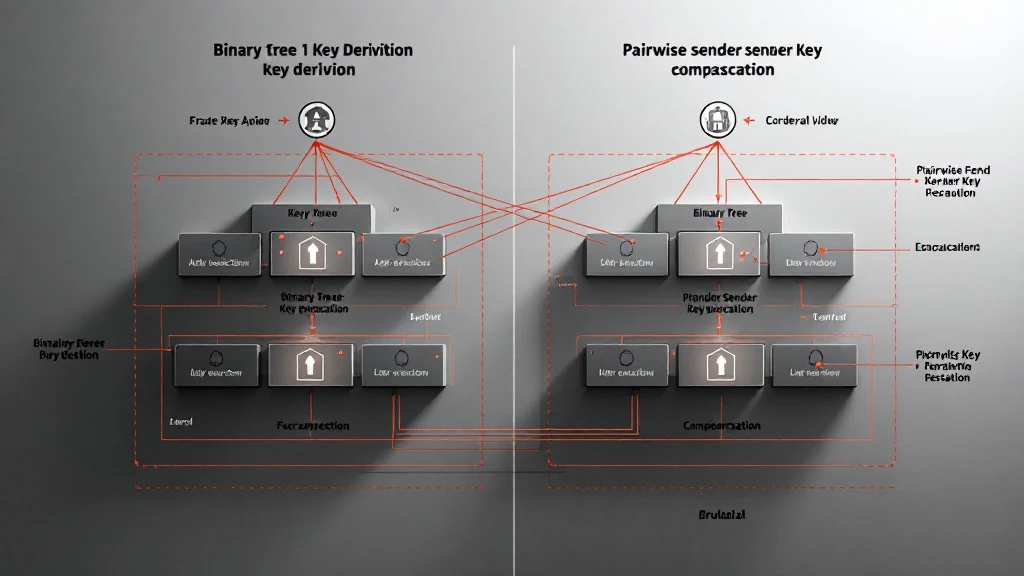
Messaging Layer Security MLS RFC 9420 is an open standard finalized by the Internet Engineering Task Force (IETF) in July 2023 that defines an end-to-end encrypted group messaging protocol. Designed by researchers from Cisco, Mozilla, Meta, Oxford, and Phoenix R&D, RFC 9420 replaces traditional pairwise re-encryption with a tree-based key management system known as TreeKEM. In traditional group chat designs using basic Signal-style pairwise channels, adding or removing a user from a group of 1,000 members requires transmitting 1,000 distinct encrypted key updates. MLS organizes group members into leaves of a balanced binary tree, allowing any single member to update the shared group secret by encrypting new epoch keys only to the logarithmic path leading to the root node.
Under RFC 9420, every client maintains state for both an application ratchet and a handshake ratchet. When a group member updates their key pair or leaves the group, they perform an update commit operation that updates keys along their tree path. This tree architecture allows MLS to scale efficiently to thousands of concurrent participants in group chats while offering both forward secrecy and post-compromise security. However, standard MLS implementations defined in RFC 9420 rely primarily on classical elliptic curve cryptography such as ECDH over Curve25519 or P-256, requiring additional extension specifications to handle quantum-resistant key exchange.
How does the LGS1 protocol handle post quantum group chat encryption?
Livara's LGS1 protocol handles group messaging encryption by deploying a hybrid sender-key architecture where symmetric group ratchets are established over hybrid post-quantum pairwise links. Rather than maintaining a global binary key tree across all participating client devices, each sender in an LGS1 group generates their own symmetric sender key sequence. When a sender joins or updates their group state, this sender key is distributed to every other participant sealed inside individual pairwise LVR1 protocol envelopes.
Because LGS1 relies on LVR1 for pairwise transport, every group key update is inherently protected against future quantum decryption. LVR1 executes a dual ratchet where P-256 ECDH and post-quantum ML-KEM-768 (standardised in NIST FIPS 203) run side by side. Key derivation relies on HKDF-SHA-256, and message payloads—including text, photos, videos, voice notes, and file captions—are encrypted using AES-256-GCM with a 12-byte nonce and 16-byte tag. When a media attachment is shared in an LGS1 group, the client generates a fresh random 32-byte content key, encrypts the file before upload, and sends the 32-byte content key inside the encrypted LGS1 payload. To learn more about how hybrid keys withstand quantum decryption, read our guide on post-quantum encryption in messaging.
How do MLS RFC 9420 and LGS1 perform an e2ee group protocol comparison?
Comparing MLS RFC 9420 and LGS1 requires evaluating key distribution overhead, post-quantum readiness, state storage requirements, and computational complexity on mobile hardware. While MLS optimises network bandwidth for extremely large groups during membership updates, LGS1 optimises processing speed and cryptographic simplicity for modern group sizes while providing instant post-quantum security out of the box.
| Feature / Metric | IETF MLS (RFC 9420) | Livara LGS1 Protocol |
|---|---|---|
| Key Management Topology | Binary Tree (TreeKEM) | Sender Key via LVR1 Envelopes |
| Rekeying Overhead (Add/Remove) | O(log N) messages | O(N) pairwise encrypted updates |
| Post-Quantum Cryptography | Classical default (PQ via extension) | Hybrid ML-KEM-768 + P-256 by default |
| Symmetric Encryption Standard | AES-128-GCM / ChaCha20-Poly1305 | AES-256-GCM (12-byte nonce, 16-byte tag) |
| Authentication Primitives | Public key signatures (ECDSA/Ed25519) | SRP authentication & ECDSA P-256 signatures |
| Out-of-band Verification | Fingerprint comparison | Safety numbers v3 key fingerprint verification |
| Client State Complexity | High (Tree path storage & state sync) | Low (Individual sender key ratchets) |
While MLS excels when scaling group sizes beyond several thousand users due to its O(log N) tree rekeying properties, it introduces significant complexity when mobile clients frequently lose synchronisation or experience dropped updates. LGS1 avoids tree synchronisation failures by isolating each member's sending key. Even in groups with dozens or hundreds of participants, modern mobile processors execute the parallel ML-KEM-768 encapsulated key exchanges in milliseconds. Users seeking to inspect cryptographic bounds can read Livara's published security boundaries or review our e2ee messaging checklist.
What recent data leaks highlight the need for advanced group encryption?
Recent cyber attacks targeting centralized communication platforms highlight how vulnerable legacy group chats remain when client-side security is absent or misconfigured. Over the past year, major data exposure incidents involved compromised server infrastructure where unencrypted backups, exposed message databases, and cleartext routing logs were exfiltrated by threat actors. When messaging systems rely on server-side decryption or transport-only encryption, a single backend database breach exposes every conversation history, attachment, and member roster across the entire network.
Furthermore, metadata harvesting remains a critical vulnerability across major messaging applications. Even when message contents are encrypted, servers that log communication patterns reveal exactly who is speaking to whom, at what times, and from which IP addresses. Livara explicitly defines its threat boundary: direct and group conversations use end-to-end encryption, while standard routing metadata (sender, destination, and delivery timestamps) is retained strictly to maintain real-time device synchronisation. Conversely, Livara public channels are unencrypted by design so that malicious broadcast streams can be reviewed and suspended. You can examine how metadata impacts user privacy in our breakdown of what messaging metadata reveals.
Frequently asked questions
What is the main difference between MLS RFC 9420 and LGS1?
MLS RFC 9420 uses a binary key tree (TreeKEM) to handle rekeying in O(log N) logarithmic steps for large groups. Livara's LGS1 protocol uses a sender-key model where individual symmetric keys are distributed to members over hybrid post-quantum LVR1 pairwise envelopes.
Does MLS RFC 9420 provide post-quantum security by default?
No. The base RFC 9420 specification uses standard classical public key primitives like ECDH over Curve25519 or P-256. Post-quantum protection in MLS requires experimental extensions, whereas Livara's LGS1 protocol integrates ML-KEM-768 (FIPS 203) by default.
Are Livara public channels protected by the LGS1 protocol?
No. Livara channels are public broadcast streams by design and are deliberately unencrypted. This allows Livara to act on abuse reports and remove illegal content. End-to-end encryption with LGS1 is reserved strictly for private group chats and direct messages.
How do safety numbers protect group messaging integrity?
Safety numbers (v3) allow group members to verify public key fingerprints out-of-band. Comparing safety numbers ensures that no adversary or server has intercepted the pairwise LVR1 exchanges used to negotiate LGS1 group sender keys.
Livara Team is the collective in-house author. This byline does not indicate independent review; assess claims using the cited sources and stated limits.