Reusing a 12-byte nonce under AES-256-GCM strips away payload integrity and exposes plaintexts. Continuous key derivation via HKDF-SHA-256 makes key-nonce collision mathematically impossible.
AES-256-GCM combined with HKDF-SHA-256 key derivation guards encrypted chat payload integrity by assigning a unique 12-byte initialisation vector (nonce) and cryptographic key to every message payload. When an adversary intercepts data to attempt a message replay attack in encryption, recipient clients reject duplicate nonces or failed authentication tags, halting payload decryption and sequence manipulation.
Key takeaways
- AES-256-GCM provides authenticated encryption but suffers total security failure if a 12-byte nonce repeats under the same key.
- HKDF-SHA-256 derives distinct per-message encryption keys continuously within a ratchet protocol, ensuring a nonce never recurs under identical keying material.
- Network adversaries attempting a message replay attack encounter mismatched sequence counters or invalid 16-byte authentication tags, causing immediate ciphertext rejection.
- While end-to-end encryption seals direct and group conversations, public broadcast channels remain readable by design to permit moderation.
How does a message replay attack compromise encrypted chats?
A message replay attack occurs when a network adversary intercepts a valid encrypted payload transmitted between two users and retransmits it to the recipient later. Because the intercepted message carries a valid ciphertext and cryptographic tag generated by the original sender, an unprotected client might accept the payload as a fresh instruction.
Without robust replay protection in private messaging, an eavesdropper sitting on a compromised network node could repeat payment requests, resend old conversation state updates, or alter message order. The adversary does not need to decrypt the payload; they merely exploit the recipient's inability to distinguish an original transmission from an unauthorised duplicate.
To neutralise this threat, modern cryptosystems enforce dual protection layers. At the network level, recipients track stateful sequence numbers to detect duplicate arrivals. At the cryptographic layer, every payload is sealed using Galois/Counter Mode (GCM) as defined in NIST SP 800-38D, which binds a unique 12-byte initialisation vector to a single message key. Attempting to replay a payload out of sequence breaks stateful verification, while altering ciphertext parameters invalidates the message tag before application processing begins.
Why does AES-256-GCM fail catastrophically upon nonce reuse?
Reusing a 12-byte nonce with the same AES-256-GCM key exposes the XOR difference between two plaintexts and allows an attacker to recover the secret authentication key (GHASH key). Once the authentication key is exposed, an adversary can forge encrypted chat payload integrity tags for arbitrary messages.
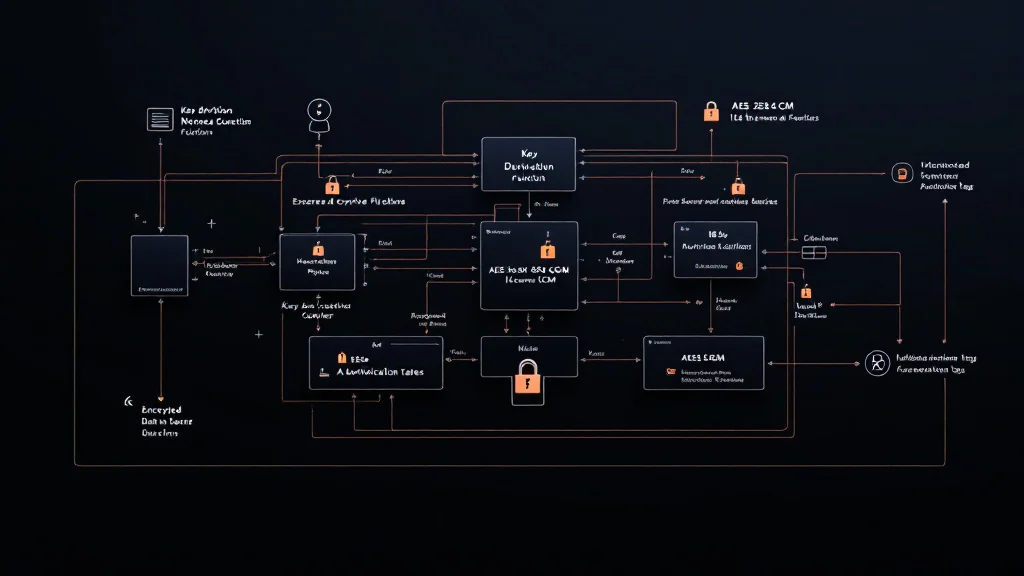
AES-256-GCM is an authenticated encryption with associated data (AEAD) scheme. It combines Counter (CTR) mode encryption with a Galois hash (GHASH) multiplier to ensure confidentiality and authenticity simultaneously. In CTR mode, the cipher generates a keystream by encrypting a counter block derived from the 12-byte nonce and a 32-bit counter. The plaintext is then XORed with this keystream to yield the ciphertext.
If two distinct messages are encrypted under the exact same key and 12-byte nonce, they share an identical keystream. An adversary who captures both ciphertexts can XOR them together, cancelling out the keystream and revealing the XOR sum of the two original plaintexts. As detailed in NIST SP 800-38D, reusing a nonce breaks the polynomial evaluation used by GHASH. An attacker can solve mathematically for the hash subkey, stripping away all payload integrity checks. From that point forward, the attacker can produce valid 16-byte authentication tags (128 bits) for forged payloads.
Preventing catastrophic aes 256 gcm nonce reuse requires ensuring that the combination of key and nonce never repeats across a secure chat session.
| Cryptographic Approach | Nonce Strategy | Key Rotation Strategy | Replay & Integrity Vulnerability |
|---|---|---|---|
| Static AES-GCM | Random 12-byte Nonce | Fixed Session Key | Collision probability rises after $2^{32}$ messages; nonce reuse exposes plaintexts and GHASH key. |
| Counter-based AES-GCM | Monotonic Counter | Fixed Session Key | Vulnerable to state desynchronisation and state rollback attacks if counter resets. |
| Ratcheted HKDF + AES-GCM | Derived / Monotonic Nonce | Per-Message Derived Key | Immune to nonce reuse across messages; compromise of one message key reveals no past or future keys. |
How does HKDF-SHA-256 ratchet security prevent nonce collision?
HKDF-SHA-256 ratchet security prevents nonce collisions by generating a fresh, cryptographically isolated message key for every payload transmitted across the network. Because key derivation continuously updates the secret state, repeating a nonce counter across distinct keys never triggers cryptographic reuse.
HMAC-based Key Derivation Function (HKDF), specified in IETF RFC 5869, uses SHA-256 in an extract-and-expand sequence to turn input key material into pseudorandom output keys. In protocols such as Livara's LVR1 double ratchet, key exchange operates continuously in two layers: an elliptic curve Diffie-Hellman (ECDH P-256) ratchet and a post-quantum epoch ratchet using ML-KEM-768 (FIPS 203).
When a user sends a message, HKDF-SHA-256 ingests the current chain key and derives two outputs: a discrete 256-bit AES message key and the next chain key. Because the AES key changes with every transmission, an initialisation vector starting at zero or incrementing monotonically pairs with a completely new key every time. Even if two message payloads happen to use identical 12-byte nonces, they are encrypted under entirely distinct 256-bit AES keys. To read more about how post-quantum key exchange combines with classical ratchets, consult our guide on post-quantum encryption in messaging.
This architecture isolates each message payload. If a device's ephemeral message key were extracted from memory, the attacker could decrypt only that single payload. They could not compute preceding keys due to the irreversibility of HKDF-SHA-256, nor future keys due to the post-quantum epoch ratchet updates. For a complete view of how these boundaries operate, examine our published security architecture.
How do payload tags and sequence counters enforce integrity?
Encrypted chat payload integrity is enforced by evaluating a 16-byte Galois authentication tag alongside strict message sequence counters before any ciphertext is decrypted. If a replayed payload arrives out of order or with tampered bytes, the authentication check fails and the message is discarded instantly.
When a message is prepared for transmission, AES-256-GCM processes the payload and any associated data (such as protocol header versioning or sender IDs). The cipher produces both the encrypted payload and a 128-bit authentication tag. Upon receipt, the recipient's client feeds the ciphertext, nonce, associated data, and derived message key into the AES-GCM decryption function.
The system enforces a strict operational rule: the ciphertext is never decrypted into readable memory until the GHASH authentication tag passes mathematical validation. If an attacker alters a single bit of the encrypted payload during transit, or attempts a message replay attack in encryption by swapping ciphertexts between sessions, tag validation fails. The client drops the frame without exposing plaintext buffers or processing unauthenticated input. For a deeper look at what authenticated payloads protect against—and what network metadata remains visible—see our analysis of what end-to-end encryption protects.
What is the boundary between sealed private chats and public channels?
End-to-end encryption and strict replay protection cover private direct messages (LVR1 protocol) and private group chats (LGS1 protocol), whereas public broadcast channels are unencrypted by design. Public channels serve as open broadcast surfaces where authors publish to unbounded audiences, allowing server-side abuse mitigation.
Understanding cryptographic claims requires clarity regarding context. In Livara, direct messages rely on the LVR1 hybrid post-quantum double ratchet, and private group chats (2 to 600 members) utilise LGS1 sender-key architecture where sender keys are sealed inside pairwise LVR1 envelopes. Group membership state is server-controlled. Voice and video calls are encrypted using standard WebRTC DTLS-SRTP (call media is not post-quantum). Attachments receive a random 32-byte content key prior to upload, passed securely inside the end-to-end encrypted session. Password verification uses Secure Remote Password (SRP) zero-knowledge proofs to ensure credentials never traverse the wire.
Channels are public broadcast streams, by design and on purpose. A broadcast channel involves a single publisher broadcasting to an arbitrary, open audience. Because broadcast streams are publicly readable, they do not use end-to-end encryption. This architectural choice permits content reporting and administrative removal of abusive broadcast content, such as child sexual abuse material (CSAM) or malicious software distribution. Private conversations remain mathematically sealed and unreadable to servers, while public channels remain fully visible and subject to platform terms. Review our detailed threat model to understand how these boundaries isolate user data.
Frequently asked questions
Can an adversary decrypt past messages if a nonce is reused once?
Reusing a nonce under AES-256-GCM reveals the XOR of the two plaintexts encrypted with that nonce and exposes the GHASH key. While it does not reveal historical keys derived via HKDF-SHA-256, it completely compromises the confidentiality and integrity of messages sharing that key-nonce pair.
How does Livara validate cryptographic integrity against tampered APKs?
Livara publishes SHA-256 build checksums allowing offline inspection of Android binaries in the Proof Lab. Users compare local APK digests against independently reproducible build hashes to confirm the client binary matches transparent cryptographic source specifications.
Why are broadcast channels exempt from end-to-end encryption?
Broadcast channels operate as public publishing platforms rather than private conversations. Omitting end-to-end encryption on public channels allows Livara to review user reports, enforce content standards, and remove abusive broadcast material without compromising the zero-knowledge privacy mechanisms guarding private direct and group messaging.
Does HKDF-SHA-256 slow down real-time message processing on mobile devices?
HKDF-SHA-256 operates with minimal computational overhead. Computing HMAC-SHA-256 derivations for key expansion takes sub-millisecond execution time on modern ARM and x86 processors, making ratchet updates virtually instantaneous during active chat sessions.