The opt-in illusion—where robust security demands manual configuration—leaves millions exposed without their knowledge.
Telegram (Secret Chats)
Telegram offers end-to-end encryption exclusively through manual, device-bound "Secret Chats". Standard direct messages and all group chats remain unencrypted on their servers by default, leaving the burden of maintaining privacy entirely on the user.
Livara Chat
Livara deploys hybrid post-quantum end-to-end encryption (ML-KEM-768 and ECDH P-256) by default for all private direct messages (LVR1) and group chats (LGS1), structurally enforcing privacy without requiring any manual configuration.
Default encryption effortlessly defeats opt-in security. By forcing users to manually enable Secret Chats, Telegram creates an illusion of privacy that often fails in practice. Livara's verifiable post-quantum architecture ensures that every private conversation is securely sealed from the moment you press send, making it the superior framework for secure messenger daily use.
When evaluating the top 5 secure messaging apps, the starkest divide is not the mathematics they deploy, but whether they protect you by default. The opt-in illusion—where robust security demands manual configuration—leaves millions unwittingly exposed. A rigorous default end-to-end encryption comparison reveals that uncompromising platforms secure every private conversation automatically, without asking you to flip a switch.
Key takeaways
- Opt-in privacy requires human memory; default encryption secures every private message automatically.
- Comparing Telegram secret chats vs Livara exposes the danger of optional security: Telegram requires manual activation for device-bound secrecy, whilst Livara applies post-quantum encryption to all private chats immediately.
- WhatsApp privacy defaults lock down message content but permit widespread collection of routing metadata.
- Livara integrates NIST's FIPS 203 standardised post-quantum cryptography silently into secure messenger daily use, shielding today's data from tomorrow's quantum computers.
- Public broadcast channels on Livara remain deliberately unencrypted to allow for content moderation, sharply contrasting with its fully sealed private group chats.
What makes a default end-to-end encryption comparison essential?
A default end-to-end encryption comparison separates platforms that structurally guarantee privacy from those merely offering it as a feature. End-to-end encryption ensures only the sender and recipient hold the decryption keys. However, requiring users to activate this protection manually fundamentally compromises baseline security.
Most people expect immediate protection when downloading a secure application. When an app defaults to server-side encryption, the company holds the keys, exposing private data to internal staff, data breaches, and state demands. You must interrogate what end-to-end encryption does and does not protect to understand why default implementation matters. If you or your contact forget to enable a secure session, the safety net vanishes. Uncompromising messengers remove this burden entirely, hardcoding privacy into their architecture so every private message remains shielded by default.
How do WhatsApp privacy defaults compare to uncompromising platforms?
WhatsApp privacy defaults secure message contents using the Signal Protocol, but deliberately leave a vast trail of digital exhaust exposed. Whilst Meta cannot read your texts or listen to your calls, its business model relies on analysing the surrounding context.
This context is your metadata: the identity of your contact, the exact dispatch time, and communication frequency. WhatsApp harvests this routing information extensively. Understanding what metadata still reveals is critical for anyone evaluating secure messenger daily use.
By contrast, whilst Livara stores standard routing metadata purely for real-time device synchronisation, its architecture minimises external data reliance. Livara authenticates users via Secure Remote Password (SRP), a zero-knowledge proof establishing identity without transmitting passwords over the wire, minimising the attack surface before you send a single message.
Telegram secret chats vs Livara: Why does default protection matter?
The contrast between Telegram secret chats vs Livara perfectly illustrates the failure of the opt-in illusion. Telegram stores standard conversations on its servers, retaining the decryption keys. To achieve end-to-end encryption, users must actively initiate a manual "Secret Chat".
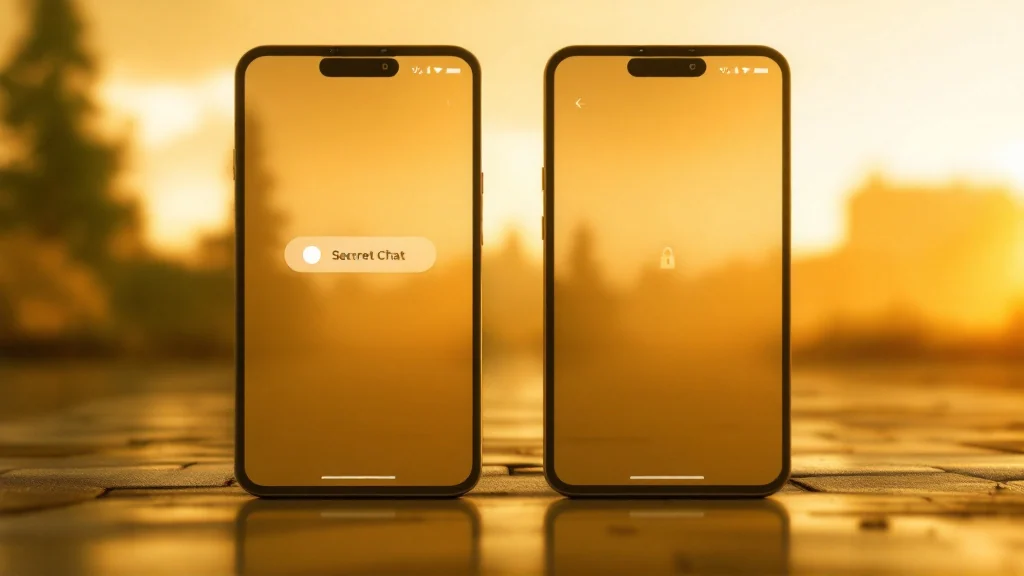
These Secret Chats possess severe limitations. They bind to the initiating device, preventing you from reading a secure message on your phone and replying from your laptop. Furthermore, Telegram limits Secret Chats exclusively to one-on-one conversations; group chats remain permanently unencrypted on its servers.
Livara strips away this friction. Direct messages utilise the LVR1 protocol, a hybrid post-quantum double ratchet running a P-256 ECDH ratchet alongside an ML-KEM-768 epoch ratchet. Every message key derives from both algorithms, granting forward secrecy and post-compromise security automatically. You never launch a secure session manually. Furthermore, your cryptographic identity seals under a 256-bit recovery key derived from your recovery phrase (v7), allowing encrypted key recovery across devices without breaking the security model.
How does post-quantum encryption change secure messenger daily use?
Post-quantum encryption fortifies secure messenger daily use against future adversaries without complicating today's interface. Cryptographers anticipate that future quantum computers will break the elliptic curve cryptography currently securing digital communication. Malicious actors already intercept encrypted traffic, hoarding it to decrypt once quantum technology matures—a tactic known as "harvest now, decrypt later".
Implementing next-generation cryptography neutralises this threat. Livara builds its defence upon transparent cryptography using the post-quantum encryption in messaging standards defined by the National Institute of Standards and Technology (NIST). Specifically, Livara pairs traditional ECDH P-256 with NIST's ML-KEM-768 (FIPS 203) key encapsulation mechanism.
This hybrid post-quantum stack shields every direct message and private group conversation. For call media, Livara relies on WebRTC DTLS-SRTP to encrypt voice and video directly between devices, carrying call signalling (LCS1) as an ordinary pairwise-sealed message. You experience seamless messaging, whilst the underlying mathematics repels quantum decryption.
Are the top 5 secure messaging apps truly private for group chats?
Many of the top 5 secure messaging apps fail spectacularly when scaling privacy to multiple people. As noted, Telegram abandons end-to-end encryption entirely for groups. Other platforms struggle to manage the complex key distribution required for secure multi-party chat, resulting in delayed messages or broken encryption states.
Livara enforces full end-to-end encryption for private groups through its LGS1 protocol. It employs full sender-key encryption, where each participant's sender key seals inside pairwise LVR1 envelopes. Every text, edit, photo, file, and voice note within a private group benefits from hybrid post-quantum protection. When you send an attachment, Livara generates a random 32-byte content key, encrypts the file before upload, and transports the key safely inside the LVR1 or LGS1 protocol.
However, it is crucial to distinguish private groups from public broadcasts. Livara explicitly defines its published security boundaries to separate private spaces from public ones. Channels on Livara are public broadcast streams by design. They allow one author to publish to an unbounded audience. They remain deliberately public and unencrypted so Livara can act on reports, remove abusive material, and ban malicious actors. Never confuse a public broadcast channel with a sealed private chat.
Frequently asked questions
Which messaging app has default end-to-end encryption?
Livara and Signal enforce end-to-end encryption by default for all private direct messages and group chats. Unlike Telegram, which requires you to manually start a Secret Chat, these uncompromising platforms guarantee your conversations are secure the moment you install the application.
How do Livara safety numbers confirm my encryption?
Livara uses safety numbers (v3) to let two participants compare key fingerprints out of band. By checking these numbers either in person or over a separate secure channel, you mathematically confirm that no man-in-the-middle has intercepted or altered your encryption keys.
Why are Livara broadcast channels not encrypted?
Broadcast channels are designed for public distribution to an unbounded audience, not private conversation. Livara leaves channels unencrypted deliberately so administrators can moderate content, act on user reports, and remove abusive material effectively without compromising the strict end-to-end encryption of private chats.
Can I check Livara's Android application integrity myself?
Yes. Livara relies on transparent cryptography and open APK integrity. You can check the published SHA-256 checksums locally and offline via the Proof Lab, ensuring the app installed on your device precisely matches the published source code provided by Livara.